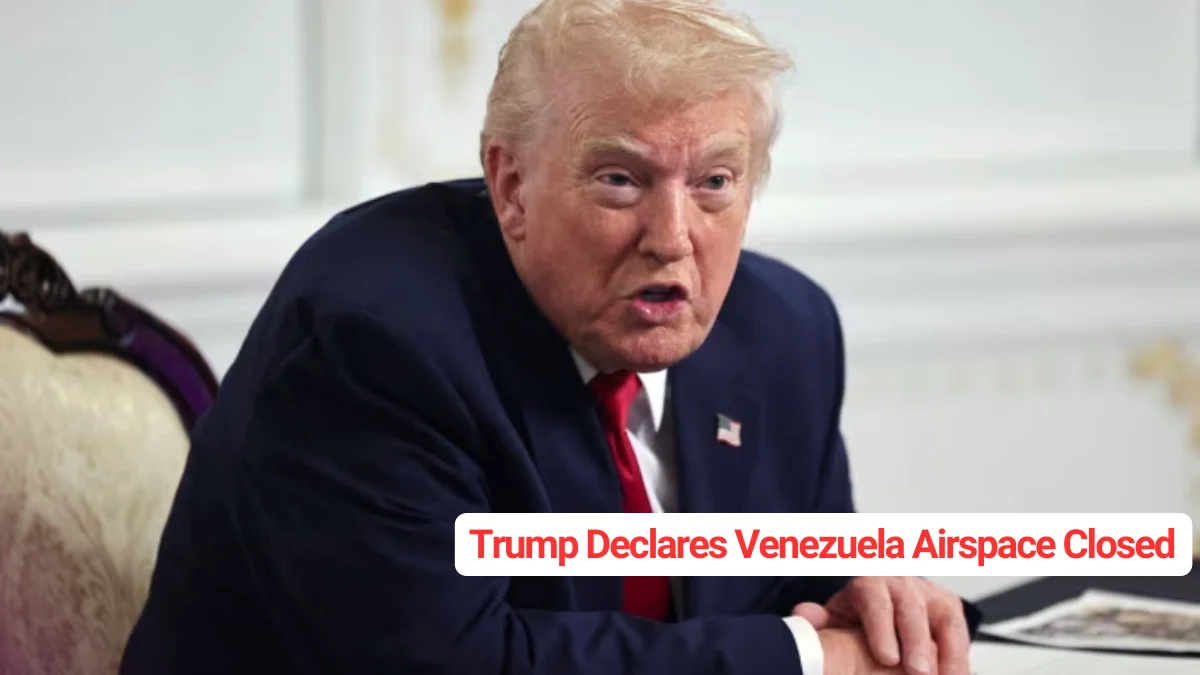
Venezuela is facing one of its most serious international crises in recent history. President Donald Trump announced that the airspace above and surrounding Venezuela should be considered closed in its entirety, marking a dramatic escalation in tensions between Washington and Caracas.
This bold declaration came through a Truth Social post on Saturday, November 29, 2025, where Trump directly addressed airlines, pilots, drug dealers, and human traffickers. The announcement has left many wondering what comes next for the troubled South American nation.
Venezuela’s Foreign Ministry quickly denounced the statement as a colonialist threat, calling it an illegal aggression against Venezuelan sovereignty. The situation has created confusion and anxiety in Caracas as the country braces for potential military action.
Key Takeaways
- Trump announced Venezuelan airspace should be considered completely closed on November 29, 2025
- The US has deployed massive military assets including the USS Gerald R. Ford carrier strike group to the Caribbean region
- Venezuela condemned the declaration as an illegal colonialist threat violating international law
- Major international airlines have already suspended flights to Venezuela following FAA warnings
- The crisis centers on US accusations of drug trafficking and the Maduro government’s alleged involvement
- Venezuela suspended deportation flights in retaliation to US pressure
- Military tensions continue to rise with potential for armed conflict
Understanding the Airspace Closure
The airspace declaration is not just symbolic rhetoric. US officials contacted by Reuters expressed surprise at Trump’s announcement and were unaware of any ongoing military operations to enforce the closure. This suggests the president made the statement without full coordination with military planners.
A retired lieutenant general who previously commanded no-fly zones explained that actually enforcing such a closure would require massive resources and careful planning. The practical implications remain unclear. Can the United States legally close another country’s airspace. The answer is no under international law. But Trump’s statement sends a powerful message about American intentions in the region.
Several major airlines had already begun avoiding Venezuelan airspace before Trump’s announcement. The Federal Aviation Administration warned last week of a potentially hazardous situation due to worsening security and heightened military activity.
Six commercial carriers suspended operations to Venezuela. In response, Caracas stripped these airlines of their landing and takeoff rights. The Venezuelan government accused them of supporting US state terrorism. This back and forth has effectively isolated Venezuela from much of international air travel.
Military Buildup in the Caribbean
The airspace closure comes amid an unprecedented American military presence near Venezuela. The USS Gerald R. Ford, the world’s most advanced aircraft carrier, leads a strike group that arrived in the Caribbean on November 16. The deployment includes seven warships, a nuclear submarine, F-35 fighter jets, and B-52 strategic bombers.
This represents the largest US military buildup in the region in decades. Trump acknowledged he signed off on plans for the CIA to operate inside Venezuela. The president also designated the Cartel de los Soles as a foreign terrorist organization earlier this week. This designation allegedly involves Venezuelan President Nicolas Maduro and his government allies.
Trump told US troops during Thanksgiving that America had stopped about 85 percent of drug trafficking by sea. He promised that land operations would begin very soon. The president specifically thanked Air Force bomber crews for their work deterring Venezuelan drug traffickers.
More than 80 people have reportedly been killed in US strikes on suspected drug boats since early September. These operations targeted vessels in the Caribbean Sea and eastern Pacific Ocean. The question now is whether military action will expand to Venezuelan territory itself.
Venezuela’s Response and Defense Preparations
President Maduro has not remained passive in the face of American threats. Venezuela condemned Trump’s statement as an extravagant, illegal and unjustified aggression. The Venezuelan government invoked International Civil Aviation Organization rules.
They stated that no outside authority can interfere with or block the use of national airspace. Defense Minister Vladimir Padrino Lopez announced activation of integral defense commands. These unite civilian and military forces under a higher phase of the Independence Plan 200. Maduro claims 82 percent of Venezuelans are ready to defend the homeland with arms if necessary.
The government has mobilized approximately 200,000 troops and militia members. Military drills and defensive preparations are visible throughout the country. Venezuela has received support from allies including Cuba, Iran, Russia, and China.
These nations condemned US actions as violations of sovereignty and international law. China urged respect for Venezuelan independence. Iran called the American threats a breach of legal norms. However, Venezuela faces serious challenges maintaining its military readiness. Reports suggest the country struggles with supplies and equipment maintenance despite the mobilization efforts.
The Drug Trafficking Allegations
At the heart of this crisis lies US accusations about Venezuelan involvement in drug trafficking. Trump designated Maduro and his government as members of a foreign terrorist organization, giving the US expanded military options for striking inside Venezuela.
Washington alleges that the Cartel de los Soles, supposedly run by top Venezuelan officials, coordinates narcotics operations. The US claims these drugs flow north toward American cities, contributing to the opioid crisis. Trump has made stopping this flow a central justification for his aggressive Venezuela policy.
Maduro strongly denies any connection to the illegal drug trade. He accuses the United States of fabricating a war against him based on false pretenses. The Venezuelan president argues that American interest in his country centers on its vast oil reserves.
Venezuela possesses the world’s largest proven petroleum reserves at approximately 300 billion barrels. Critics of US policy point to this wealth as the real motivation behind regime change efforts. They describe the drug trafficking narrative as a convenient excuse for intervention.
Impact on Venezuelan People
Ordinary Venezuelans find themselves caught between escalating international tensions and a collapsing economy. Inflation is projected to reach 180 to 500 percent by the end of 2025. About 50 percent of the population lives in poverty. Shortages of food, water, fuel, and medicine have become routine. Caracas residents who spoke to Reuters criticized Trump’s announcement.
Many expressed fear about what military conflict would mean for their families. Over 7 million Venezuelans have fled the country since 2014. The exodus represents one of the largest refugee crises in the Western Hemisphere.
The suspension of deportation flights adds another layer of complexity. Venezuela announced that repatriation flights carrying Venezuelan migrants have been unilaterally suspended by the United States. This impacts Trump’s mass deportation program.
Venezuelans living illegally in America now face uncertainty about their status. Meanwhile, those hoping to return home through official channels find themselves stuck. The airspace crisis has human consequences that extend far beyond military maneuvering.
What Happens Next
The international community watches nervously as this standoff intensifies. Trump’s airspace declaration could be simple messaging or a prelude to actual military action. Former US Ambassador to Venezuela Charles Shapiro said the announcement turns up the pressure on Maduro significantly.
But analysts remain divided on whether Washington will follow through with force. Experts note that while Trump’s statement represents an escalation on paper, whether the US will actually attack remains to be seen. The president has hinted at possible talks with Maduro. Reports emerged of a phone call between the two leaders, though details remain unclear.
Venezuela continues to rally international support against what it calls American aggression. Latin American opinion shows division. Some polls suggest 53 percent of people in the region support US intervention to remove Maduro.
Others view such action as dangerous imperialism. Inside Venezuela, approximately 80 percent of citizens reportedly want Maduro out. But that does not mean they support foreign military action to achieve regime change. The situation remains fluid and unpredictable. Each new statement from Trump or response from Maduro adds another layer of tension to an already explosive situation.