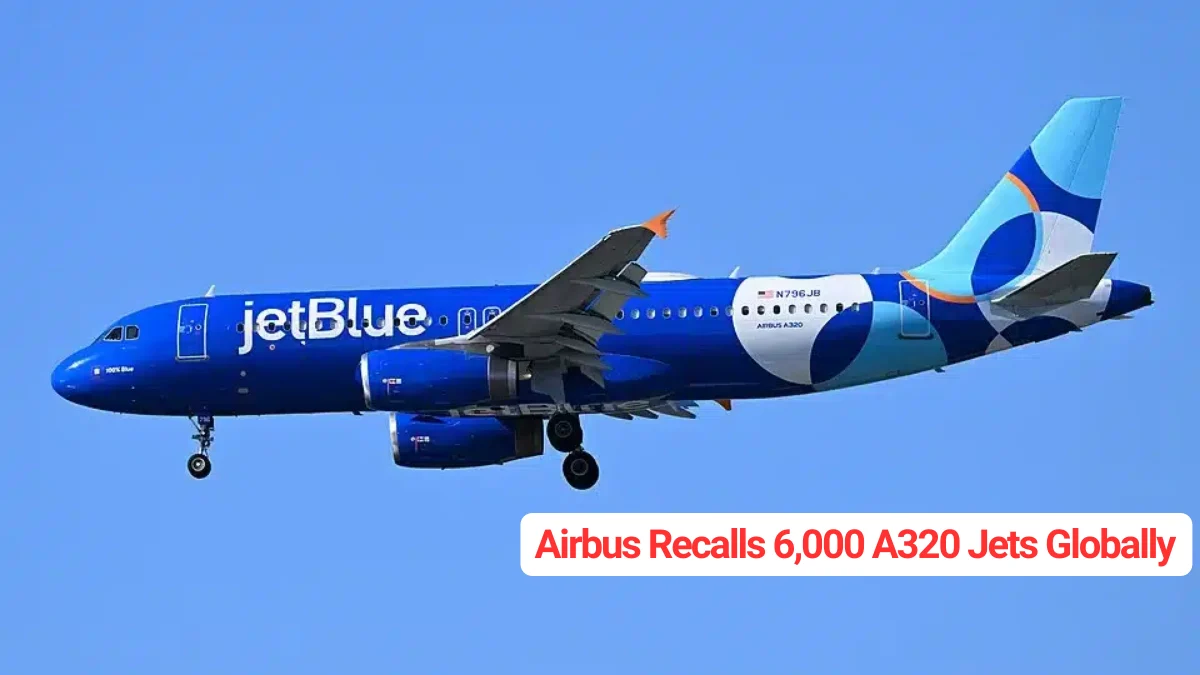
Airbus has launched one of its largest safety recalls in history, affecting approximately 6,000 A320-family aircraft globally after a mid-air incident exposed a critical software vulnerability. The emergency directive comes at the worst possible time right during peak holiday travel season forcing airlines to ground planes for urgent software updates.
The recall was triggered by an October 30 incident on a JetBlue flight from Cancun to Newark, where the aircraft experienced an uncommanded pitch-down that hospitalized passengers. Investigators traced the problem to corrupted flight control data caused by intense solar radiation flipping bits in the plane’s fly-by-wire systems. The issue affects the A319, A320, and A321 models, representing over half of the global A320 fleet of approximately 11,300 aircraft.
The European Union Aviation Safety Agency issued an emergency directive on November 28, requiring a two-hour software rollback per aircraft before the next flight. Airlines worldwide are racing to comply, but the timing has created massive disruptions across continents, with thousands of cancellations hitting travelers during US Thanksgiving and Asia-Pacific holiday rushes.
Key Takeaways
- 6,000 A320-family planes require immediate software updates due to solar radiation-induced flight control data corruption
- The recall follows an October 30 JetBlue incident where uncommanded pitch-down hospitalized passengers
- Two-hour software fix mandated per aircraft by EASA before next flight
- Airlines report thousands of cancellations and delays globally, hitting peak holiday travel
- India grounded 350 planes from IndiGo and Air India for 2-3 days
- Most fixes expected to complete by early next week

Global Flight Disruptions Hit Peak Travel Season
The recall has created chaos at airports worldwide. Over 3,000 A320s were mid-flight when the directive was announced, amplifying operational nightmares for airlines trying to minimize passenger impact.
In the United States, airlines are scrambling during the busiest travel week of the year. American Airlines, the largest A320 operator with 209-340 affected aircraft, expects to complete overnight fixes by Saturday. Delta Air Lines reported minimal delays, completing updates by November 29 morning. JetBlue remains under FAA investigation following the trigger incident.
India faces the most severe domestic impact. The DGCA mandated immediate upgrades for all A319/A320/A321 aircraft, grounding approximately 350 planes. IndiGo delayed 250+ flights, urging passengers to check mobile apps for updates. Air India Group’s domestic services face widespread disruptions through November 30-December 1.
Airlines Racing Against Holiday Travel Demand
Asia-Pacific carriers are feeling the squeeze hardest. Japan’s ANA Holdings canceled 65 flights on November 29, affecting both mainline and affiliate operations including Peach Aviation. Australia’s Jetstar grounded 34 of 85 A320s, canceling 90 domestic and international flights, with three-hour queues reported at Sydney and Melbourne airports.
The Philippines saw 62 domestic flights canceled by Cebu Pacific, while Philippine Airlines and AirAsia Philippines reported 10 cancellations and 11 delays as of 11 AM November 29. Colombia’s Avianca took the most drastic action, halting 70% of its fleet and suspending ticket sales until December 8.
Here’s how major global carriers are handling the crisis:
| Airline | Affected Aircraft | Impact Level | Resolution Timeline |
|---|---|---|---|
| American Airlines (US) | 209-340 | Minimal delays | Saturday completion |
| Delta Air Lines (US) | ~100 | Few delays | Nov 29 AM complete |
| IndiGo (India) | ~250 | 250+ flights delayed | Nov 30-Dec 1 |
| Air India Group (India) | ~100 | Widespread disruptions | Nov 30-Dec 1 |
| ANA Holdings (Japan) | Portion of fleet | 65 flights canceled | Ongoing |
| Jetstar (Australia) | 34 of 85 | 90 flights canceled | 3-hour fixes per plane |
| Avianca (Colombia) | 70% of fleet | Ticket sales halted | December 8 |

The Science Behind the Software Glitch
The root cause involves cosmic rays intense solar radiation that can flip digital bits in aircraft fly-by-wire systems. This phenomenon disrupted autopilot functions, navigation systems, and structural limit calculations. Aviation experts call it an invisible threat to modern digital aviation technology.
The software vulnerability represents a rare intersection of space weather and aviation safety. While cosmic radiation effects on electronics are well-documented, this marks one of the first major commercial aviation incidents directly attributed to solar-induced data corruption. The fix involves rolling back to previous software versions proven resistant to radiation interference.
Public Reaction and Safety Praise
Social media conversations show 70% negative sentiment focused on travel disruptions, 20% neutral news sharing, and 10% positive reactions praising Airbus’s swift safety response. Hashtags like #AirbusA320, #A320Recall, and #FlightDelays are trending across US, India, Australia, and Japan.
Frustrated travelers dominate online discussions. Indian passengers suggest switching to railways for domestic routes. Australian travelers share airport queue photos with captions like “Good thing I flew yesterday.” Dark humor surfaces with jokes comparing the situation to recent Boeing troubles.
However, aviation experts and some passengers commend the proactive safety measures. Posts highlight how the recall prevents potentially catastrophic structural overload scenarios. Pilots praise the “safety-first” approach, calling the temporary inconvenience worthwhile for long-term reliability.
Airlines demonstrating transparency earn positive mentions. IndiGo and Air India’s quick mobile app updates receive praise. Delta’s overnight completion with minimal holiday disruption stands out as a best-case handling example.
The recall comes weeks after the A320 overtook Boeing’s 737 as the most-delivered commercial jet, marking a bitter milestone in Airbus’s 55-year history. While fixes should wrap up by early next week, the incident exposes modern aviation’s vulnerability to environmental factors affecting digital systems.